
Your Brain Is Wired to Focus on New Things: Don’t Just Compete on the Basics
Countless actors have appeared as their own evil twin in TV, movies, stories or games. Just like the old “It was all a dream” trope, it offers an escape hatch for a stalled story that puts characters at a crossroads, unsure of what happens next.
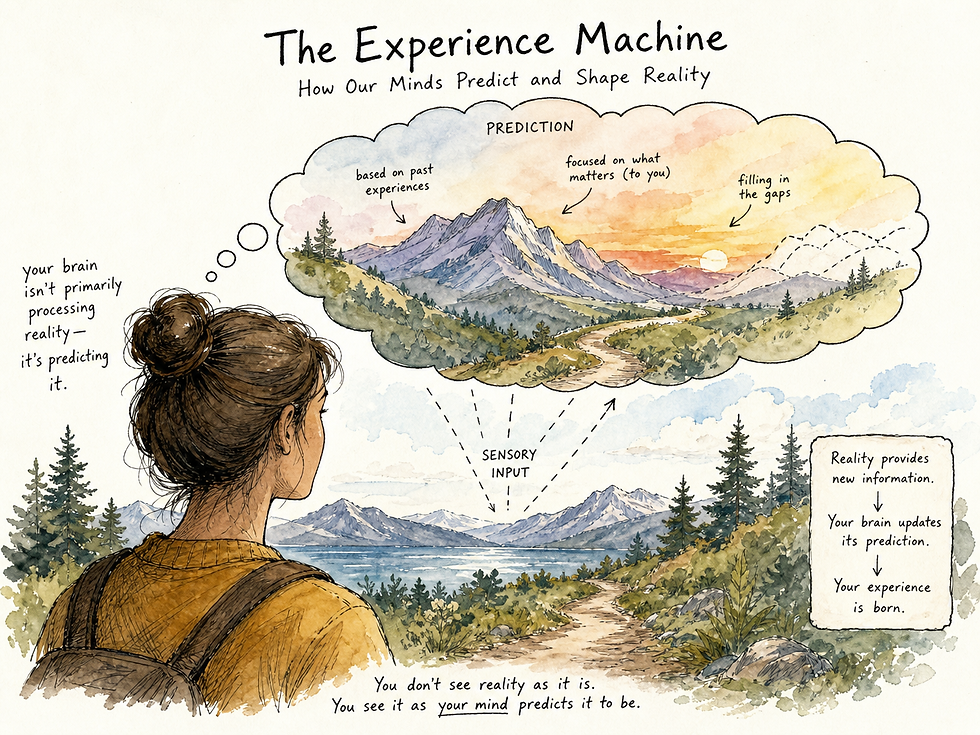
Cognitive expert Andy Clark writes about how the human mind has evolved to “predict” how a scenario will play out. Then, we envision a next step or two and even the anticipated outcome.
The Prediction Machine You're Pitching To
Cognitive scientist Andy Clark makes a striking claim in his 2023 book The Experience Machine: How Our Minds Predict and Shape Reality: your brain isn't primarily processing reality — it's predicting it. At every moment, your mind is running a quiet forecast of what's about to happen next, then checking incoming information against that model.
When the world confirms your prediction, your brain barely registers it. Efficient. Automatic. Forgettable.
When something doesn't match the prediction? Attention sharpens. Memory consolidates. The moment gets prioritized and retained.
This has a direct consequence for anyone trying to land a message in a business context — in a pitch, a proposal, a presentation, a sales conversation, or even an email.
So, any unexpected twist earns even more mindshare and attention.
We are constantly looking at scenarios and planning ahead on a response to an expected question or situation. Clark's research points to a more useful competitive lever: the well-placed surprise.
Not gimmickry — but a genuine reframe, a counterintuitive finding, an insight the audience hadn't already counted.
In practice, this might look like:
● Leading with the conclusion your audience didn't expect you to reach
● Naming an objection before they can raise it — and taking it seriously
● Quantifying something they assumed was unquantifiable
● Challenging a widely-held assumption in your industry, with evidence
● Framing a familiar problem through an entirely different lens
Create a small moment of prediction error — and in that moment of recalibration, you have their full, unguarded attention. THAT’s when a message actually lands.
I saw this in practice early in my career when a highly-touted Rotary Club luncheon speaker in Jacksonville, Fla. surprised his packed auditorium by revealing that he wasn’t a British diplomat, but a Kansas actor hired to show how people respond to a posh, polished accent and claims of global expert connections.
When he revealed the surprise, this ordinary speech about education policy became a serious lesson with an Aha! moment.
